Illustrative example (not a real person): an artist uploading a first batch of ten designs to Redbubble might start seeing small print-on-demand royalty payments within a few months if any of the designs land on searches. A catalogue of thirty or so on-trend designs is roughly the scale at which small monthly royalties become predictable rather than sporadic. Whether that translates to a meaningful monthly figure depends heavily on niche selection, keyword targeting, and how the design market moves — we don’t have Sri Lanka-specific royalty data to project a typical figure.
Selling digital art is a create-once-sell-repeatedly income model. You draw or design a piece, upload it to marketplaces, and receive royalties or downloads each time someone buys. The property is real. Whether it produces a monthly figure worth naming depends on how well your designs match what buyers are actually searching for.
This guide covers the realistic income, which platforms accept Sri Lankan sellers, what equipment you actually need, and how to avoid the most common mistakes beginners make.
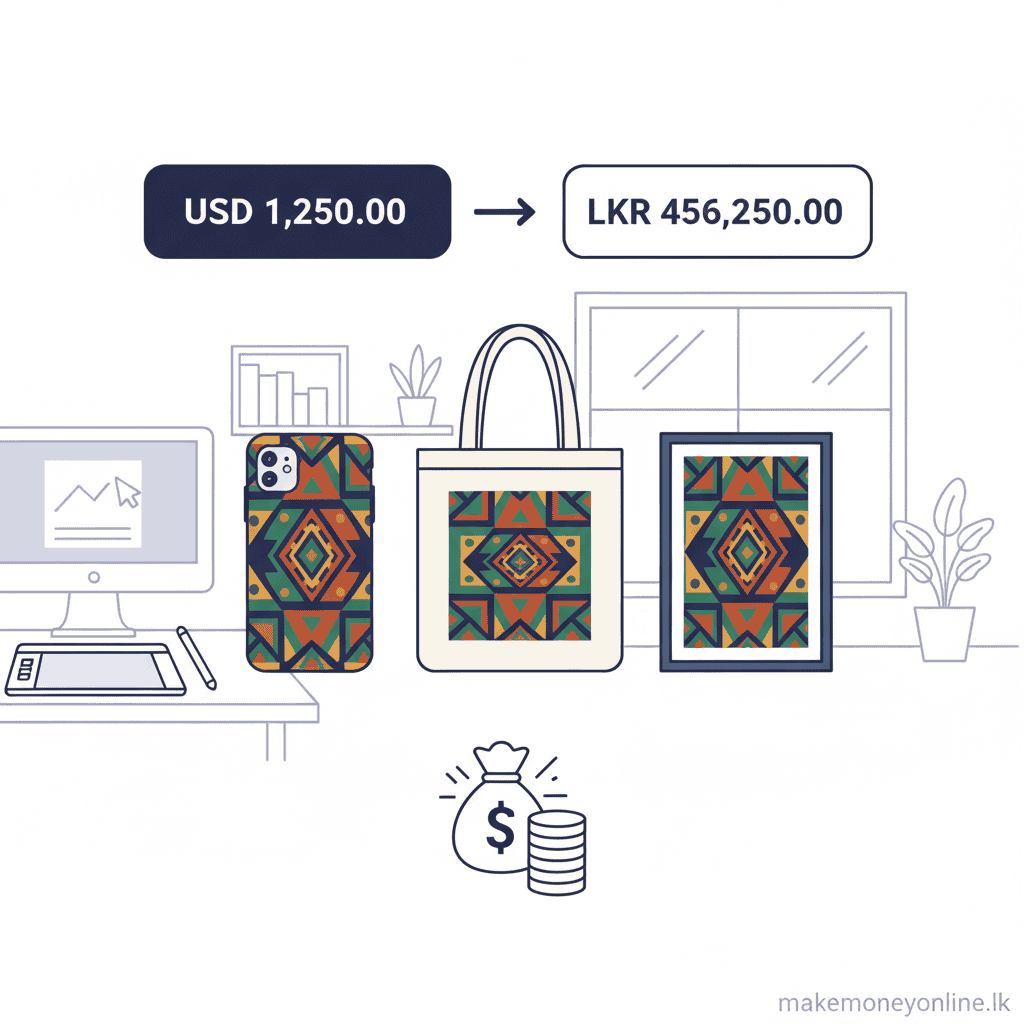
What Is Selling Digital Art?
Selling digital art means creating visual artwork in digital format and monetizing it through one or more of these channels:
Print-on-demand (POD): Upload your design to platforms like Redbubble, Society6, or Merch by Amazon. When a customer buys a mug, t-shirt, or print featuring your design, the platform handles printing, shipping, and customer service. You earn a royalty per sale (typically 10 to 25% of the sale price).
Digital downloads: Sell your artwork as downloadable files on Etsy, Gumroad, or your own website. Buyers pay once to download the file and can print it themselves, use it as wallpaper, or use it commercially (if you grant a commercial license). No inventory, no shipping, no production cost.
Stock illustration: Upload vector illustrations and patterns to Adobe Stock, Shutterstock, or Freepik and earn royalties each time a buyer licenses the image for their project.
Commissioned artwork: Accept custom illustration orders from clients who need specific digital artwork for their businesses, book covers, game assets, or personal projects.
Sri Lankan artists can compete globally in all four models. The print-on-demand and digital download models are the most passive, requiring the most upfront work for the most ongoing income.
How Much Can You Earn from Selling Digital Art in Sri Lanka?
Earnings depend significantly on your niche, the number of designs live in your store, and which platforms you sell through.
Digital Art Income Benchmarks
| Channel | Beginner (per month) | Intermediate (per month) | LKR Equivalent (Intermediate) |
|---|---|---|---|
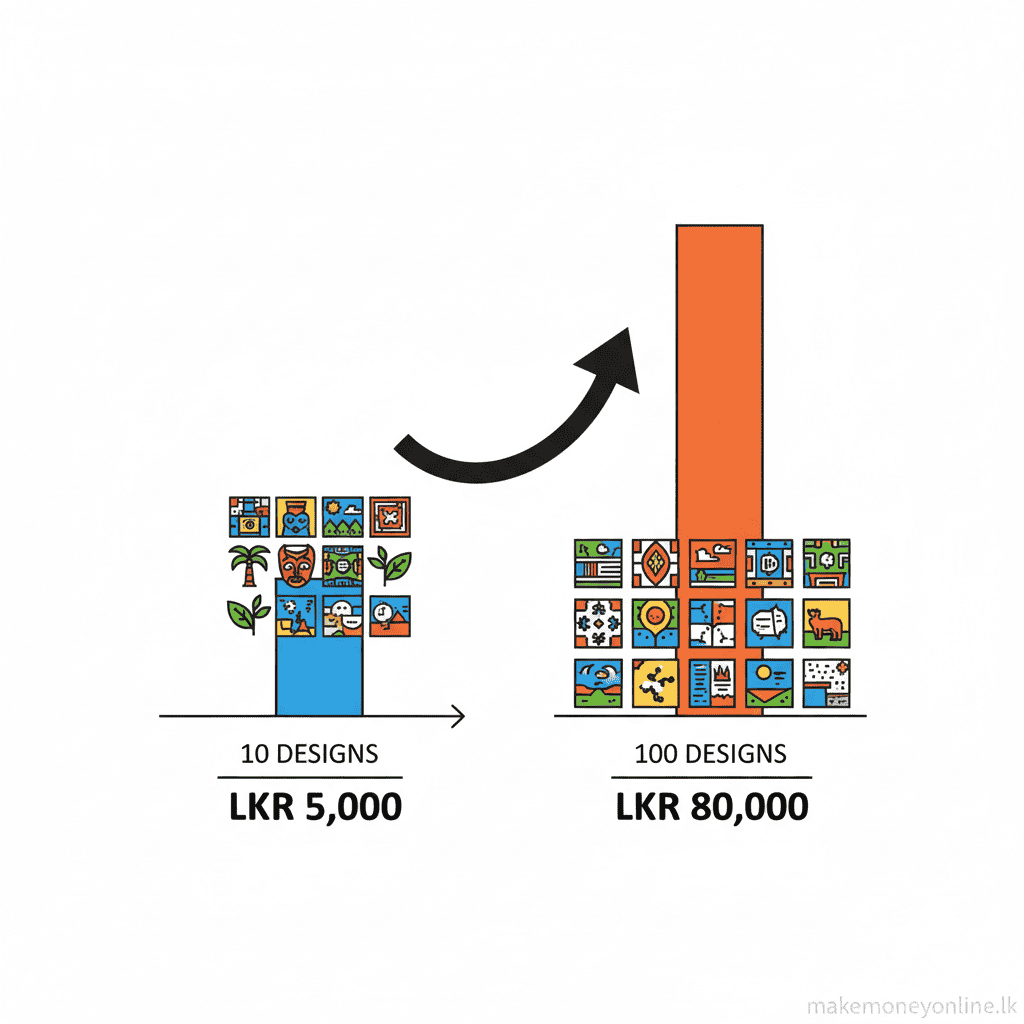
| Print-on-demand (10–30 designs) | LKR 5,000 to LKR 20,000 | LKR 30,000 to LKR 80,000 | Direct LKR |
| Digital downloads on Etsy | $20 to $60 | $100 to $400 | LKR 30,500 to 122,000 |
| Stock illustration (100+ assets) | $30 to $80 | $150 to $500 | LKR 45,750 to 152,500 |
| Commissioned artwork | $50 to $150 | $200 to $600 | LKR 61,000 to 183,000 |
USD → LKR conversion notice. USD-to-LKR figures on this page use a reference rate of approximately LKR 305 per USD, last reviewed 2026-09-01. Actual conversion depends on your provider’s spread and the current market rate. See our methodology. A Sri Lankan artist with 50 Redbubble designs and a well-optimized Etsy shop with 20 digital download listings can realistically earn LKR 60,000 to LKR 120,000 per month after 12 to 18 months of consistent uploading and optimization.
How Does Selling Digital Art Work?
Print-on-demand model:
Step 1: Create a design in your software (Procreate, Adobe Illustrator, or free alternatives). Save as a high-resolution PNG (at least 4000px x 4000px for most POD platforms).
Step 2: Upload to Redbubble or Society6. Write a title, tags, and description that describe the design and appeal to the buyer who would want it. Enable the design on all product types (the platform handles printing on each product).
Step 3: Customers discover your work through platform search or external traffic. They order the product. The platform prints, ships, and handles customer service.
Step 4: You receive a royalty payment monthly. Redbubble pays via PayPal or direct bank transfer only — Payoneer support has been removed (verified 2026-09-02, Redbubble getting-paid help). Payment threshold lowered from $20 to $10 on 1 July 2026.
Digital downloads model:
Step 1: Create the artwork and export as the appropriate file format (PNG, PDF, SVG, or ZIP bundle).
Step 2: List on Etsy or Gumroad with clear product images showing how the file looks when used. Set your price. Write a description with keywords buyers use when searching.
Step 3: Buyers purchase and receive an automatic download link. You receive payment.
Step 4: Etsy is not directly accessible for Sri Lankan sellers (Sri Lanka is not on Etsy Payments’ or Etsy’s Payoneer-eligible-country list); Sri Lankan sellers use a US LLC or an eligible-country bank as a workaround. Gumroad pays via direct bank deposit or PayPal only (Payoneer, Wise, and wire transfer are NOT supported). Verify each platform’s current Sri Lanka payout status inside your account before committing time.
What Skills Do You Need for Selling Digital Art?
Drawing or design ability: This is the core requirement. You do not need formal training. What matters is a consistent style that appeals to buyers in your chosen niche. Many successful POD artists have a simple, clean illustration style that photographs well on products.
Understanding of print-ready file specifications: Knowing how to export files at the correct resolution, color mode (RGB vs CMYK), and file format for each platform. This is technical knowledge you can learn in a few hours.
Keyword research for art marketplaces: Redbubble and Etsy are search-driven. Learning how to write tags and titles that match what buyers actually search for is as important as the art quality itself.
Niche selection: Knowing which subjects sell (nature, pets, typography, pop culture, seasonal, spiritual, cultural) versus which are oversaturated or unlikely to convert.
Volume and consistency: Successful POD artists upload consistently. Ten designs are not enough to build meaningful passive income. Fifty to two hundred designs across focused niches are typically needed before income becomes reliable.
How to Get Started Selling Digital Art in Sri Lanka
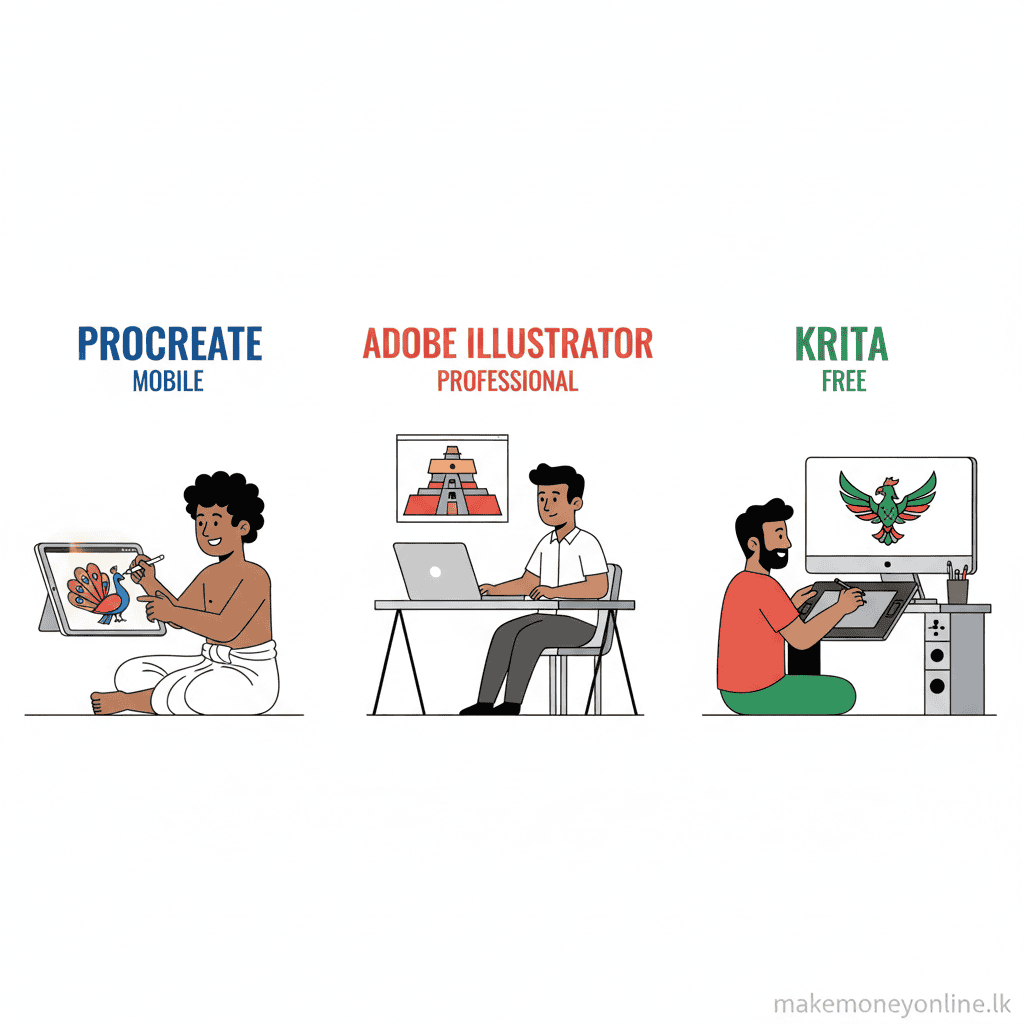
Step 1: Choose your tools. Procreate on iPad (LKR 3,000 to LKR 4,500 one-time app cost, requires iPad) is the most popular tool for illustration. Adobe Illustrator (LKR 7,015/month via Creative Cloud) is the industry standard for vector work. Krita (free, Windows/Mac) is a capable free alternative.
Step 2: Pick a niche before drawing. Research what sells on Redbubble and Etsy before creating. Search trending topics in categories like: pet breeds (Golden Retriever, Dachshund), hobbies (cycling, yoga, hiking), professions (nurse, teacher, engineer), cultural themes, and seasonal (Christmas, Halloween). Create designs where searches show demand but competition is manageable.
Step 3: Create your first 10 to 20 designs. Focus on one niche initially. Consistent niche artists rank faster in marketplace search than artists with scattered random uploads.
Step 4: Open accounts on Redbubble and Etsy. Redbubble accepts Sri Lankan sellers directly. Etsy does not — Sri Lanka is not on Etsy Payments’ eligible-country list, so direct signup as a Sri Lankan-based seller is blocked. Redbubble is free to join. If you set up Etsy via a US LLC or eligible-country bank, Etsy’s fee stack is $0.20 per listing + 6.5% transaction fee + payment processing (~3% + $0.25) + optional 12-15% offsite ads fee if applied.
Step 5: Set up Payoneer. Redbubble pays via PayPal or direct bank transfer only — Payoneer is no longer supported (Redbubble getting-paid help, verified 2026-09-02). Payment threshold lowered to $10 on 1 July 2026. Etsy is not directly accessible for Sri Lankan sellers — Sri Lanka is on neither Etsy Payments’ nor Etsy’s Payoneer-eligible list; Sri Lankans use a US LLC or an eligible-country bank as a workaround.
Step 6: Upload consistently. Aim for 2 to 5 new designs per week for the first six months. Marketplace algorithms favor active sellers who upload regularly.
Step 7: Learn basic SEO for marketplaces. Use the full 13-tag allowance on Redbubble. Write descriptive Etsy listings using keywords buyers actually search. Tools like eRank (etsy-specific keyword tool, free tier available) help identify high-traffic, low-competition search terms.
How to Learn Digital Art for Commercial Sales
Free resources:
- YouTube: Channels like Teela Brown (Society6 and POD strategy), Hannah Ebeling, and Mei Pak cover POD business strategy, niche research, and design optimization.
- Krita tutorials (krita.org/en/learn): Official tutorials for the free Krita software, covering digital painting and illustration from beginner level.
- Procreate handbook (procreate.com): Official free handbook covering every Procreate feature.
Paid learning:
- Domestika digital illustration courses (from USD 10 to USD 20 or LKR 3,050 to LKR 6,100 on sale): High-quality illustration and character design courses from professional artists. Strong focus on creating commercially appealing work.
- Udemy print-on-demand courses (USD 15 to USD 30 or LKR 4,575 to LKR 9,150): Specific courses on Redbubble niche research, Etsy digital download optimization, and POD business scaling.
Pros of Selling Digital Art
Genuinely passive after upload. Once a design is live on Redbubble or as an Etsy digital download, it can generate income indefinitely with no additional work per sale. Sri Lankan artists with 100+ designs live receive daily sales notifications while doing other work.
No inventory, no shipping. Print-on-demand handles everything after the digital upload. Digital downloads require no fulfillment at all. There is no upfront inventory investment, no shipping costs, and no storage concerns.
Low startup cost. An iPad with Procreate (LKR 30,000 to LKR 80,000 for entry iPad + LKR 3,000 to LKR 4,500 for Procreate) or a laptop with Krita (free) is the full setup cost. Redbubble is free to join.
Income scales with design count. More designs mean more chances for buyers to find and purchase your work. The relationship between design count and income is not perfectly linear, but it is real.
Cultural designs have an underserved market. Sri Lankan patterns, motifs, batik-inspired designs, and local cultural themes are underrepresented on international POD platforms. Sri Lankan artists creating authentic cultural designs face less competition than Western-style illustration.
Cons of Selling Digital Art
Slow income build. Print-on-demand income does not become meaningful for most artists until they have 50 to 100+ designs live and have optimized their marketplace presence. This typically takes six to twelve months of consistent uploading.
Algorithm and platform dependency. Redbubble and Etsy both have search algorithms that can change. Some artists see significant income drops after algorithm updates. Building presence on multiple platforms reduces but does not eliminate this risk.
Design theft and copyright infringement. Successful digital art designs get copied. Images get taken from your listings and uploaded to other POD platforms. Tools like Google Reverse Image Search help monitor for theft, but removal requires filing DMCA notices, which is time-consuming.
Volume requirements are real. Beginner artists who upload 5 to 10 designs and then stop uploading will not generate meaningful income. Success in POD specifically requires a volume-based approach: consistent uploads over 6 to 18 months.
POD profit margins per sale are low. On a $25 Redbubble t-shirt, you might earn $3 to $5 as royalty. High volume is required for significant monthly income. Lower-cost digital downloads on Etsy have higher margin percentages but require more active promotion.
Best Platforms for Selling Digital Art in Sri Lanka
Redbubble
The most popular print-on-demand marketplace for independent artists. Free to join. Buyers discover your work through Redbubble’s marketplace search.
- Royalty: You set your margin above Redbubble’s base price (typically 10 to 30% over base)
- Payment for Sri Lanka: Payoneer (minimum $20 threshold)
- Best for: Illustration, character art, pattern design, pop culture-adjacent work
Etsy — not directly accessible for Sri Lankan sellers
The world’s largest handmade and digital goods marketplace. But Sri Lanka is on neither Etsy Payments’ eligible-country list nor Etsy’s Payoneer-eligible-country list (verified against Etsy’s own countries-eligible-for-Etsy-Payments help article, 2026-09-02). Sri Lankans who list on Etsy do so via a US LLC (Stripe Atlas) or a personal bank account in an eligible country.
- Fees (if you’re set up via an eligible country): $0.20 per listing + 6.5% transaction fee + payment processing (~3% + $0.25) + optional 12–15% offsite ads fee. Effective total roughly 9.5% + $0.45 on a typical sale.
- Payment for Sri Lanka: not directly supported. See the caveat above.
- Best for: printable wall art, clip art, design bundles, digital planners — for sellers willing to set up a US LLC or eligible-country bank first.
Society6
Similar to Redbubble but with a design-focused, premium audience. Higher product quality perception, slightly lower organic discovery traffic.
- Royalty: Fixed rates per product type (approximately 10% artist margin)
- Payment for Sri Lanka: Payoneer
- Best for: Fine art prints, home decor designs, lifestyle illustration
Adobe Stock / Freepik
Stock illustration platforms for designers and marketers. Pay per download or subscription license. Better for vector illustration and pattern work than character art.
- Royalty: 20 to 33% per download on Adobe Stock; tiered rates on Freepik
- Payment for Sri Lanka: Payoneer (Adobe Stock), Payoneer or bank wire (Freepik)
- Best for: Vector illustrations, patterns, icons, UI elements
Free Tools for Selling Digital Art
Krita (free): Professional digital painting application for Windows, Mac, and Linux. Full brush engine, layer support, and export options. Best free alternative to Photoshop for illustration.
Inkscape (free): Open-source vector graphics editor. Alternative to Adobe Illustrator for creating scalable vector designs. Required knowledge for pattern and icon design.
Canva (free tier): Useful for creating product mockup images showing how your art looks on a mug, frame, or tote bag. Mockup images significantly improve listing click-through rates.
eRank (free tier): Etsy keyword research tool. Shows search volume, competition, and trending terms for Etsy listings.
Paid Tools for Selling Digital Art
Procreate (LKR 3,000 to LKR 4,500 one-time, iPad only): The most popular illustration app for digital artists. Intuitive brush engine, excellent for hand-drawn illustration style that performs well on POD platforms.
Adobe Illustrator (approximately USD 23 per month or LKR 7,015 as part of Creative Cloud): Industry standard vector tool. Essential if your work involves scalable designs, typography, or patterns that need to maintain quality at any print size.
iPad (LKR 60,000 to LKR 150,000 one-time): Required for Procreate. Entry-level iPad models (iPad 9th or 10th generation) work well with Apple Pencil for digital drawing.
Scam Alerts: Digital Art Red Flags
Fake Commission Requests That Skip Payment
A common scam targeting digital artists involves a client requesting a detailed custom illustration, receiving the work, and then disputing the payment, claiming the work was “not what they requested.” Always require a 50% upfront deposit before beginning any commissioned work. Deliver final files only after receiving full payment.
Overpayment Check Scams
A “client” pays for a commission by check for more than the agreed amount and asks you to refund the difference. The check bounces after you have sent the refund. This is a classic overpayment scam. Never refund money from a payment that has not fully cleared. Use platforms with built-in escrow (like Fiverr or Upwork) for commissioned work whenever possible.
“Exposure” Payment for Large Projects
Requests for full illustration series, book cover sets, or extensive commercial designs in exchange for “portfolio exposure” or “credit” rather than payment are exploitation. Established brands and publishers pay industry rates. Delivering hours of professional work in exchange for exposure is not a business arrangement.
Plagiarism Targeting Your Work
If you upload successful designs, expect to find copies on other platforms. Monitor your designs using Google Reverse Image Search and TinEye. When you find copies, file DMCA takedown notices with the platform hosting the stolen work. Most platforms (Redbubble, Amazon Merch, Etsy) have copyright violation reporting tools that remove infringing listings within a few days.
Final Verdict: Is Selling Digital Art Worth It for Sri Lankans?
Selling digital art is a legitimate passive income method with a genuine ceiling for skilled, consistent artists. The startup cost is low, the income is genuinely passive after upload, and the international marketplace means Sri Lankan artists earn USD-equivalent income regardless of local economic conditions.
The honest challenge is that this is a slow, volume-based business. Artists who upload 10 to 20 designs expecting quick income will be disappointed. Those who treat it as a long-term project, uploading consistently for 12 to 18 months while learning what their niche buyers want, build sustainable monthly income.
This method suits you well if:
- You can draw or design and enjoy creating visual work
- You can invest in an iPad with Procreate (or use free tools like Krita) to produce quality digital art
- You are willing to upload consistently for 6 to 12 months before expecting meaningful income
- You want genuinely passive income that grows with your design catalogue
This method may not suit you if:
- You need income within 30 to 60 days
- You are not willing to produce a high volume of designs (50 to 100+ over 12 months)
- You dislike the idea of your work being reprinted on products you do not control
For those interested in related creative income methods, see the guide on selling stock photos in Sri Lanka and the overview of graphic design freelancing for complementary skills that build on digital art ability.
Related Ways to Earn Money Online in Sri Lanka
- Graphic Design — Apply design skills to freelance client work
- Selling Digital Products — Expand into other digital product types
- Print on Demand — Put your art on physical products
- Selling Traditional Art — Sell both digital and traditional art online
Looking for more ways to earn? Browse our complete guide to making money online in Sri Lanka with 63 online income methods reviewed for legitimacy, skill and time requirements, and payment access from Sri Lanka. See our methodology for how each method is assessed.