Sri Lanka is one of the most visually diverse countries in the world. Beaches, wildlife, temples, tea estates, street markets, traditional crafts, festivals, and urban life are all within a few hours of each other. International buyers on stock photo platforms need exactly this kind of content, and they are not finding enough of it.
A Sri Lankan photographer with a decent camera (even a recent smartphone) and basic photo editing skills can build a stock photo portfolio that earns passive LKR income every month. The income is not instant and the per-photo royalty is small. But the income compounds as the portfolio grows, and the photos keep earning for years after you take them.
This guide covers how stock photography works from Sri Lanka, which platforms pay Sri Lankan contributors, what actually sells, and how to avoid the most common mistakes beginners make.
What Is Selling Stock Photos?
Stock photography means taking photos, uploading them to stock licensing platforms, and earning royalties each time someone downloads or licenses your image. The buyer pays the platform. The platform pays you a royalty percentage. You do not deal with buyers directly.
There are two main licensing types:
Royalty-free licensing: The buyer pays once and can use the image multiple times. You as the contributor earn a royalty each time a new buyer licenses the same image. One photo can earn royalties from hundreds of buyers over years.
Rights-managed licensing: Less common in stock photography. The buyer pays based on specific usage (print run, region, duration). Higher single-payment but less passive.
For beginners, royalty-free stock photography on platforms like Shutterstock, Adobe Stock, Getty Images, and iStock is the standard model.
Contributors earn between $0.25 and $5.00 per image download depending on the platform, the buyer’s subscription tier, and the image quality level. A portfolio of 500 images earning an average of $0.50 per download and being downloaded 200 times per month generates $100 (LKR 30,500) per month passively.
How Much Can You Earn Selling Stock Photos in Sri Lanka?
Sri Lankan stock photographers typically earn LKR 3,000 to LKR 15,000 per month with a portfolio of 100 to 300 images across major platforms. Photographers with 500 to 1,500 well-optimized images earn LKR 25,000 to LKR 80,000 per month. Full-time stock photographers with 2,000 or more images across multiple platforms and niche focus earn LKR 100,000 to LKR 250,000 per month.
Income Reality Check
Stock photography income is highly dependent on portfolio size, niche, and keywording quality. The royalty per image download is small. Volume and passive accumulation over years drive meaningful income.
| Portfolio Size | Monthly Downloads | Average Royalty | Monthly Income (LKR) |
|---|---|---|---|
| 100 images | 30 to 60 | $0.40 | LKR 3,660 to 7,320 |
| 500 images | 150 to 300 | $0.40 | LKR 18,300 to 36,600 |
| 1,500 images | 500 to 1,000 | $0.45 | LKR 68,625 to 137,250 |
| 3,000+ images | 1,500 to 3,000 | $0.50 | LKR 228,750 to 457,500 |
USD → LKR conversion notice. USD-to-LKR figures on this page use a reference rate of approximately LKR 305 per USD, last reviewed 2026-09-01. Actual conversion depends on your provider’s spread and the current market rate. See our methodology. Building a 1,500-image portfolio typically takes 12 to 24 months of consistent uploading. This is a long-game method. Photographers who approach it as a passive income investment rather than an immediate income source succeed far more often.
How Does Selling Stock Photos Work?
Step 1: Create a Contributor Account
Sign up as a contributor on your chosen platform. Each platform has an approval process. Shutterstock requires submitting 10 sample images for review. Adobe Stock reviews each image upload individually. Getty Images is highly selective and invitation-based for new contributors. Start with Shutterstock and Adobe Stock, which accept new contributors most openly.
Step 2: Understand What Sells
Not all photos sell equally. Stock buyers are commercial users: bloggers, designers, marketers, and publishers who need images for specific purposes. The images they buy must be technically clean and commercially applicable.
High-demand categories:
- Business and technology: people working on laptops, teams in meetings, office environments
- Lifestyle: diverse people exercising, cooking, reading, socializing
- Nature and travel: Sri Lankan wildlife, beaches, mountains, rural landscapes
- Food: local Sri Lankan cuisine is underrepresented and in demand
- Cultural: traditional festivals (Vesak, Sinhala and Tamil New Year, Kandy Perahera), crafts, and heritage sites
What does not sell well:
- Tourist shots of famous landmarks (thousands of identical images already exist)
- Blurry or poorly composed photos regardless of subject
- Photos with visible brand logos or trademarks (need releases to submit)
- Photos of identifiable people without a model release form
Step 3: Take and Edit Photos
Technical quality standards are strict on stock platforms. Images must be:
- In focus (sharp on the primary subject)
- Well-exposed (not too dark, not overblown highlights)
- Minimal noise (avoid high ISO settings in poor lighting)
- At least 4 megapixels resolution (most stock platforms require 6 to 8 megapixels minimum)
Edit photos lightly in Lightroom (free mobile version) or Snapseed (free) to correct exposure, color balance, and remove distracting elements.
Step 4: Keyword and Upload
Keywording is critical. Buyers search for images using keywords. An image of a Sri Lankan tea plantation with poorly chosen keywords will never be found. Spend as much time on keywords as on editing.
For each image, write 10 to 50 relevant keywords covering: the subject, location, mood, activity, colors, and potential uses. A photo of the Ella Rock hiking trail should include keywords like: “Sri Lanka,” “Ella,” “hiking,” “mountain trail,” “nature,” “travel,” “Asia,” “green landscape,” “tropical,” and “outdoor adventure.”
Step 5: Wait and Repeat
Your first few images will earn very little. Most images earn their first downloads within one to four weeks of upload. Keep uploading. The cumulative effect of a large, well-keyworded portfolio across multiple platforms is where meaningful income comes from.

What Skills Do You Need for Stock Photography?
Photography basics: You need to understand exposure (aperture, shutter speed, ISO) and composition. This does not require a professional camera. A recent mid-range smartphone camera (Pixel, Samsung Galaxy S series, iPhone 13 or newer) produces images that meet stock platform technical requirements. A budget DSLR or mirrorless camera significantly improves your options.
Basic photo editing: Every stock photo needs post-processing to meet platform standards. Lightroom Mobile (free) is the standard tool for adjusting exposure, color balance, and removing blemishes. Snapseed (free) is a capable free alternative.
Keywording ability: Writing accurate, comprehensive keywords for each image is as important as the photography itself. Learn how stock buyers search for images and keyword accordingly.
Consistency: Stock photography income requires volume. Uploading 10 images this month and nothing for three months produces minimal results. A consistent upload schedule of 50 to 100 images per month builds a portfolio at the right pace.
Understanding of model and property releases: Any photo of an identifiable person requires a signed model release before it can be sold commercially. Photos of private buildings, logos, or branded products require property releases. Learn which photos require releases before shooting, not after.
How to Get Started Selling Stock Photos in Sri Lanka
Step 1: Check your equipment. A smartphone with a camera of 12 megapixels or higher is sufficient to start. A dedicated camera (entry-level DSLR like Canon EOS 1500D or mirrorless like Sony A6000) produces higher-quality images with more creative control. Do not buy new equipment before you have submitted 50 images and confirmed you enjoy the process.
Step 2: Sign up on Shutterstock. Go to submit.shutterstock.com and create a contributor account. Submit 10 sample images for the initial approval review. Approval typically takes three to seven business days. Once approved, you can upload as many images as you want.
Step 3: Sign up on Adobe Stock. Go to contributor.stock.adobe.com and create an account. You can upload directly via the web interface. Each image goes through individual review (usually 24 to 48 hours).
Step 4: Photograph what sells from Sri Lanka. The most commercially valuable Sri Lankan content includes: street food preparation (be aware of release requirements if faces are visible), wildlife (elephants, leopards, birds), tea plantation landscapes, traditional ceremony and festival imagery, beach and coastal scenery from unique angles (not just sunset on Unawatuna), and cultural crafts like batik or mask-making in process.
Step 5: Master keywording before your first upload. Before uploading your first batch of images, read Shutterstock’s free keywording guide. Poor keywords mean zero downloads regardless of image quality.
Step 6: Set up a Sri Lanka payout method. Shutterstock pays contributors via PayPal, Payoneer, or Skrill — Payoneer is the most reliable option for withdrawing to a Sri Lankan bank (see our payment methods guide for the current status of each rail). Important Shutterstock-specific gotcha: if you already use Payoneer for another platform, Shutterstock requires a separate Payoneer account (different email) for Shutterstock payouts. Adobe Stock pays through third-party providers that vary by region — check inside your contributor account for which specific provider is available for Sri Lanka before you build a strategy around it. Alamy pays PayPal or bank transfer.
Step 7: Upload consistently. Aim for 50 to 100 new images per month. Review your download analytics monthly to understand which subjects and styles are selling.
How to Learn Stock Photography
Free resources:
- Shutterstock Contributor Learning Center (contributor.shutterstock.com/blog): Official guides on keywording, technical requirements, and what sells.
- Adobe Stock Contributor Academy (helpx.adobe.com/stock/contributor): Platform-specific tutorials on uploading, reviewing, and optimizing submissions.
- YouTube: Search “stock photography for beginners 2025.” Channels like Stockphoto Secrets and Envato Tuts+ cover practical tutorials for building a portfolio.
- Pond5 Blog (pond5.com/blog): Covers stock photography and video. Strong keywording guides.
Paid learning:
- Udemy stock photography courses (USD 15 to USD 30 or LKR 4,575 to LKR 9,150 during sales): Course content varies. Look for courses specifically about keywording strategy and earning optimization, not just camera technique.
- Formal photography education is not necessary for stock photography. Technical skill from practice and study of what sells is more valuable than certifications.
Pros of Selling Stock Photos
Passive income that compounds over time. Each image earns royalties long after you take it. A photo of a Sri Lankan kingfisher taken three years ago can still earn downloads today. The income grows as the portfolio grows without requiring proportionally more work.
Sri Lanka is underrepresented in stock libraries. Most stock platforms have limited coverage of Sri Lanka compared to Western countries. A Sri Lankan photographer producing quality local content fills a real gap that international buyers actively search for.
Low starting cost. A smartphone and free editing apps are enough to start. The investment is time, not equipment.
Flexible hours. Photography happens when and where you choose. There are no client deadlines or revision requests.
Multiple platform income. The same photo can be sold on Shutterstock, Adobe Stock, Depositphotos, and other platforms simultaneously. One upload earns from multiple sources.
Cons of Selling Stock Photos
Very low per-image royalty. Individual royalties range from $0.25 to $2.00 on standard subscription sales. Building meaningful income requires hundreds to thousands of images. Beginners underestimate how long this takes.
Highly competitive overall. Global stock libraries have hundreds of millions of images. Generic subjects (landscapes, sunsets, basic food) face intense competition. Niche and unique content from specific locations (like Sri Lanka) has better chance of standing out.
Strict technical requirements. Blurry, noisy, or poorly edited photos are rejected. Some platforms reject 30% to 50% of submissions from new contributors. Rejection is a learning tool, not a failure, but it slows portfolio building.
Revenue depends entirely on platform algorithm. How often your images appear in search results on Shutterstock or Adobe Stock depends on their internal ranking algorithm. You have limited control over visibility beyond good keywording.
Sri Lanka payout options are platform-specific. The main stock platforms use different payout rails and different subsets of the PayPal / Payoneer / Skrill / bank-transfer combination. Sri Lanka’s PayPal usability for withdrawals is more restricted than it looks from PayPal’s Sri Lanka landing page — see our payment methods guide for the current per-provider status. Verify your specific payout method inside each contributor account before building a strategy around it.
It takes time to build meaningful income. A 100-image portfolio earns very little. The first three to six months are low-yield. Most photographers who quit do so before they have built enough volume to see meaningful returns.
Best Platforms for Selling Stock Photos in Sri Lanka
Shutterstock
Shutterstock is the largest stock photo platform and the most common starting point for new contributors.
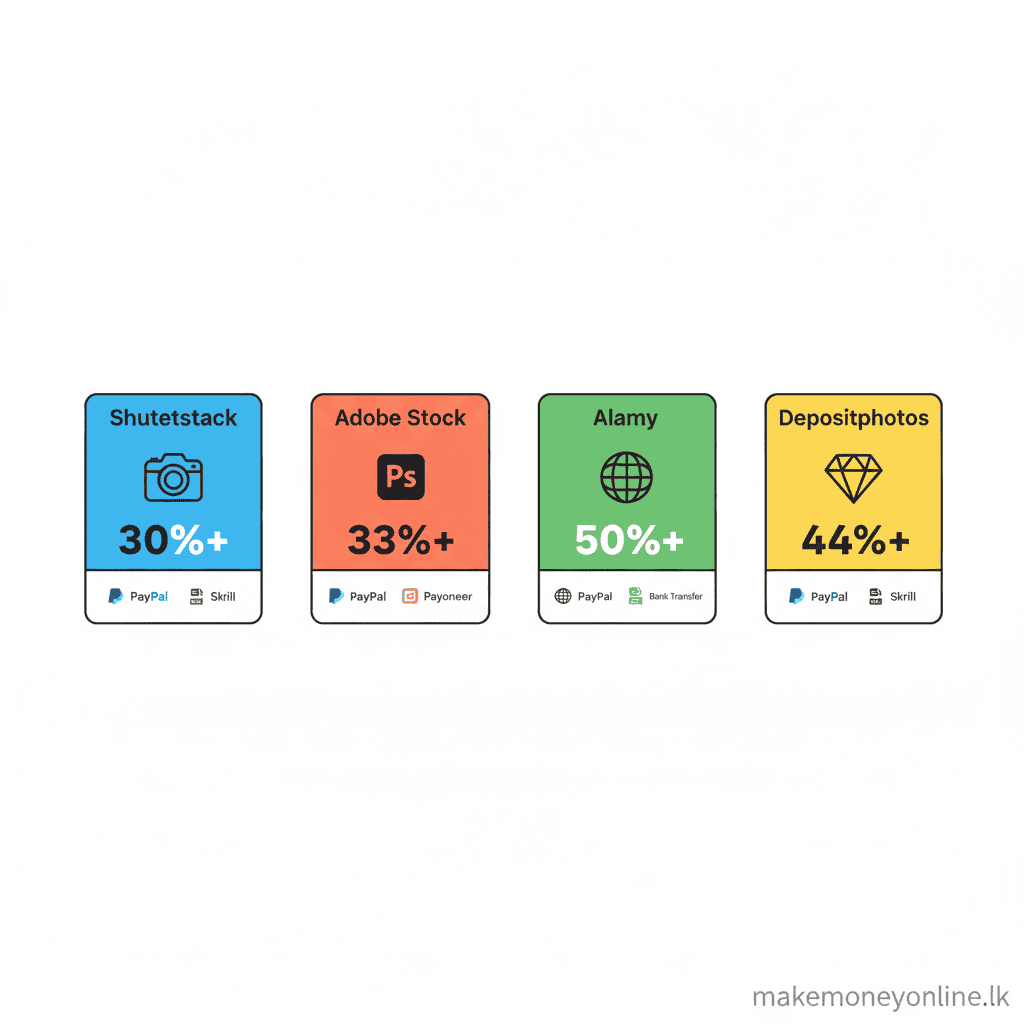
- Royalty structure (verified 2026-09-01): tiered from 15% (entry level) to 40% (top) based on the number of licenses you sell in the current calendar year. The tier resets to 15% every January. This is the single most important detail most third-party guides omit — you should model your yearly income knowing you drop back to the entry tier each January and have to earn your way up again over the year.
- Image and video are separate tracks, so you progress each independently.
- 2025 alternative-payout model: for certain unlimited-download Shutterstock subscribers, contributors now receive 50% of net revenue on that subscriber’s downloads instead of the fixed tier rate. This is applied automatically per subscriber; there is nothing you need to opt into.
- Payment methods (verified 2026-09-01): PayPal, Payoneer, or Skrill. Payments issue between the 7th and 15th of each month once you clear the threshold.
- Payoneer setup gotcha: if you already have a Payoneer account for another employer/marketplace, Shutterstock requires you to create a separate Payoneer account (different email) for Shutterstock payouts.
- Payment threshold: $35 minimum payout (verify in-account before withdrawal).
- Approval process: 10 sample images reviewed before account activation.
Adobe Stock
Adobe Stock is integrated into Adobe Creative Cloud apps, so designers actively using Photoshop and Illustrator see your images without leaving their workflow. This drives strong passive discovery — a real structural advantage.
- Royalty rate (verified against Adobe’s own contributor help): ~33% for photos, vectors, and illustrations; ~35% for video and motion assets — of the net sale amount.
- Payment threshold: $25 minimum. Additional payouts can be requested each time the $25 threshold is met.
- Payment methods for Sri Lanka: payments issue in USD via third-party providers; specific provider availability varies by region and is shown in your contributor account. Adobe does not publish a global “Sri Lanka works with X” statement — confirm the provider list inside the contributor payout settings before submitting.
- Advantage: higher per-download rate than Shutterstock’s entry tier, and the tier does not reset annually.
Alamy
Alamy pays contributors up to 50% of each direct sale. Buyer volume is lower than Shutterstock’s, but per-sale earnings can be materially higher — especially for editorial content.
- Royalty rate: up to 50% of the sale price on direct sales.
- Payment thresholds: Alamy publishes thresholds in GBP — approximately £50 (~$65) for PayPal and £100 (~$130) for bank transfer. Verify against Alamy’s current terms.
- Payment methods: PayPal or bank transfer. USD, GBP, and EUR are supported currencies.
- New from 1 September 2026: Alamy monitors total licence fees per contributor per Revenue Year. If you are on Alamy Silver and your total licence fees exceed US $3,000 during the Revenue Year, your commission automatically upgrades to Alamy Gold for future sales in that year. Silver contributors with high-value editorial work benefit from this the most.
- Best for: editorial content (news, cultural events, documentary), where Alamy’s per-sale price is materially higher than Shutterstock’s subscription-driven downloads.
Depositphotos
Depositphotos is a mid-tier platform with a strong Eastern European buyer base and a growing global presence. Reasonable as a third or fourth platform, not a primary.
- Royalty rate: 34% to 42% depending on the sale type and contributor level.
- Payment methods for Sri Lanka: PayPal and wire transfer historically supported; verify current in-account options.
- Best for: supplementary income alongside Shutterstock and Adobe Stock.
Free Tools for Stock Photography
Lightroom Mobile (free from Adobe): The standard free tool for stock photo editing. Adjust exposure, color balance, and remove noise. Saves to cloud and exports in full resolution.
Snapseed (free, Google): Free mobile editing app. Strong healing brush for removing distracting elements. Good for quick edits on mobile before upload.
Google Keyword Planner: While designed for Google Ads, it provides search volume data for keywords that also apply to stock photo searches.
Shutterstock Contributor App (free): Upload directly from your phone, view earnings, and manage submissions.
Adobe Lightroom Presets (free versions widely available): Pre-built editing looks that speed up color correction. Search “free Lightroom presets” for nature or landscape photography.
Paid Tools for Stock Photography
Adobe Lightroom Classic (approximately USD 12 per month or LKR 3,660 as part of Creative Cloud Photography plan): The desktop version of Lightroom with more powerful organization and batch editing tools. Necessary if you are uploading 100 or more images per month and need efficient batch processing.
Canva Pro (approximately USD 13 per month or LKR 3,965): Not for stock photos directly, but for creating keywording templates, shot lists, and organizing your upload workflow.
Microstock Expo membership or similar stock analytics tools (USD 20 to USD 50 per month or LKR 6,100 to LKR 15,250): Track your portfolio performance across multiple platforms. Useful once you have 500 or more images and need to identify which subjects and styles generate the most downloads.
Scam Alerts: Stock Photography Red Flags in Sri Lanka

Fake Photo Buying Websites
Some websites claim to buy photos directly from photographers at high rates (LKR 500 to LKR 2,000 per photo). They ask you to submit 20 to 50 photos as a “trial batch” and then either pay nothing, demand more photos, or disappear entirely.
Legitimate stock photography income comes through established platforms with transparent royalty structures. Any website asking you to submit photos to an unknown buyer without a clear, established royalty system is a risk.
Image Theft Without Attribution or Compensation
Your stock photos, once uploaded to legitimate platforms, are protected by licensing. However, some websites and social media users download your images from stock platforms with valid licenses and then reuse them beyond their license scope. Others steal watermarked preview images and use them commercially.
You can report image theft through each platform’s built-in reporting tool. Shutterstock and Adobe Stock have dedicated teams for license compliance. If you discover your images being used commercially without license, contact the platform’s licensing team.
Paid “Stock Photography Training” From Unverified Sources
Some Sri Lankan social media groups advertise stock photography training for LKR 15,000 to LKR 50,000 promising “insider tips” for getting approved and earning more downloads. Most of this content is available free from the platforms themselves.
The platforms’ official contributor guides and blogs are the best sources of accurate, current information. Paid training from unverified sellers adds cost without proportionate value.
Fake “Exclusive Contracts” Locking You Into Low Royalties
Be cautious of agencies or websites that ask you to sign exclusive contributor agreements. Exclusive contracts mean your images can only be sold through that platform. If that platform has low download volumes or low royalty rates, you miss out on income from other platforms.
Major platforms like Adobe Stock and Alamy support non-exclusive submission, meaning you can list the same images on multiple platforms simultaneously. Retain non-exclusive rights whenever possible.
Copyright Claims on Your Own Photos
A rare but growing issue: automated copyright claim systems can flag your own original photos as potential infringements if your images contain recognizable elements (famous buildings, branded products) or if your images were previously uploaded elsewhere. Always keep originals, upload dates, and metadata as proof of original ownership.
Final Verdict: Is Selling Stock Photos Worth It for Sri Lankans?
Stock photography is a genuine passive income method for Sri Lankan photographers who commit to building a large, well-keyworded portfolio over 12 to 24 months. It rewards consistency and patience more than technical mastery.
The advantages for Sri Lankans are real: local content is underrepresented on global stock platforms, the diverse Sri Lankan landscape and culture provide subjects that international buyers actively need, and the USD earnings convert favorably.
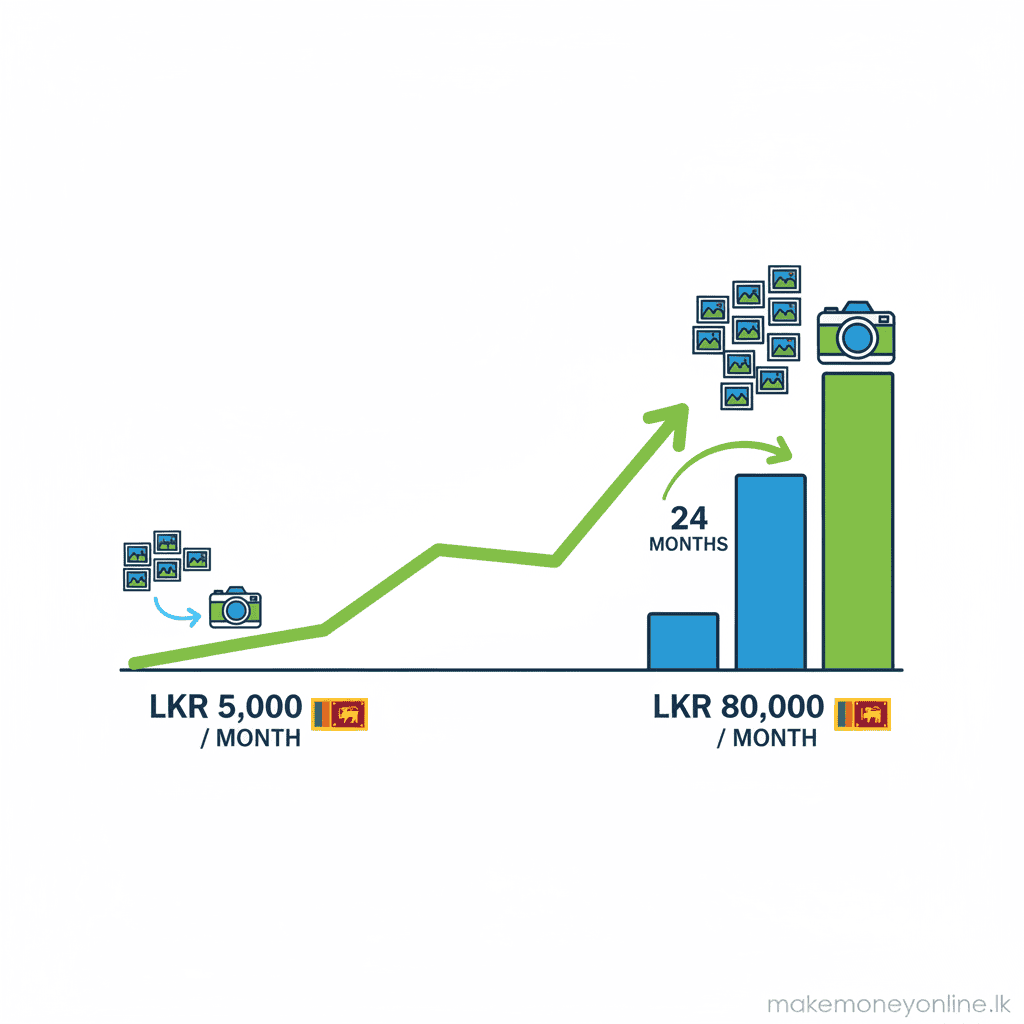
The honest limitation: this is a slow-build method. Earning LKR 5,000 per month from stock photos takes six to twelve months of consistent work. Earning LKR 50,000 per month takes two to three years of dedicated portfolio building. Anyone promising faster results is misleading you.
This method is well-suited for you if:
- You already own a decent camera or smartphone and enjoy photography
- You are willing to build income gradually over 12 to 24 months
- You want passive income that does not require daily active work after the initial portfolio build
- You have unique access to Sri Lankan subjects that international buyers need (wildlife, cultural events, local cuisine)
This method may not suit you if:
- You need income within the next three to six months
- You do not enjoy photography or find the editing process tedious
- You expect significant income from a portfolio of fewer than 500 images
For photographers interested in expanding their creative income, see the guide on selling digital art in Sri Lanka and the overview of selling traditional art online, both of which use creative skills for income in different ways.
Related Ways to Earn Money Online in Sri Lanka
- Renting Photography Gear — Earn from equipment when not shooting
- Selling Digital Art — Sell edited photos and digital art assets
- Travel Vlogging — Combine travel photography with vlogging
- Blogging — Start a photography blog for additional income
Looking for more ways to earn? Browse our complete guide to making money online in Sri Lanka with 63 online income methods reviewed for legitimacy, skill and time requirements, and payment access from Sri Lanka. See our methodology for how each method is assessed.